When Do Puppies Sleep Through the Night? What to Expect
By Team · July 12, 2026
Category: training-behavior

Puppies can't sleep through the night right away — here's the biological reason why, what the waking patterns mean, and how to build a schedule that moves things in the right direction.
Key takeaways
The problem Puppy night waking isn't bad behavior — it's a small bladder doing what small bladders do.
Core insight Keeping nighttime responses calm and brief teaches puppies that waking up offers nothing interesting.
Practical outcome Match your expectations to your puppy's age and you will stop mistaking normal development for a problem.
One of the most searched questions from new puppy owners — when do puppies sleep through the night? — has an honest answer that most blogs bury: not for a while, and that's completely normal. What you're dealing with right now isn't a training failure. It's a small animal with a small bladder and an immature nervous system, doing exactly what small animals do.
Why Puppies Can't Sleep Through the Night Yet
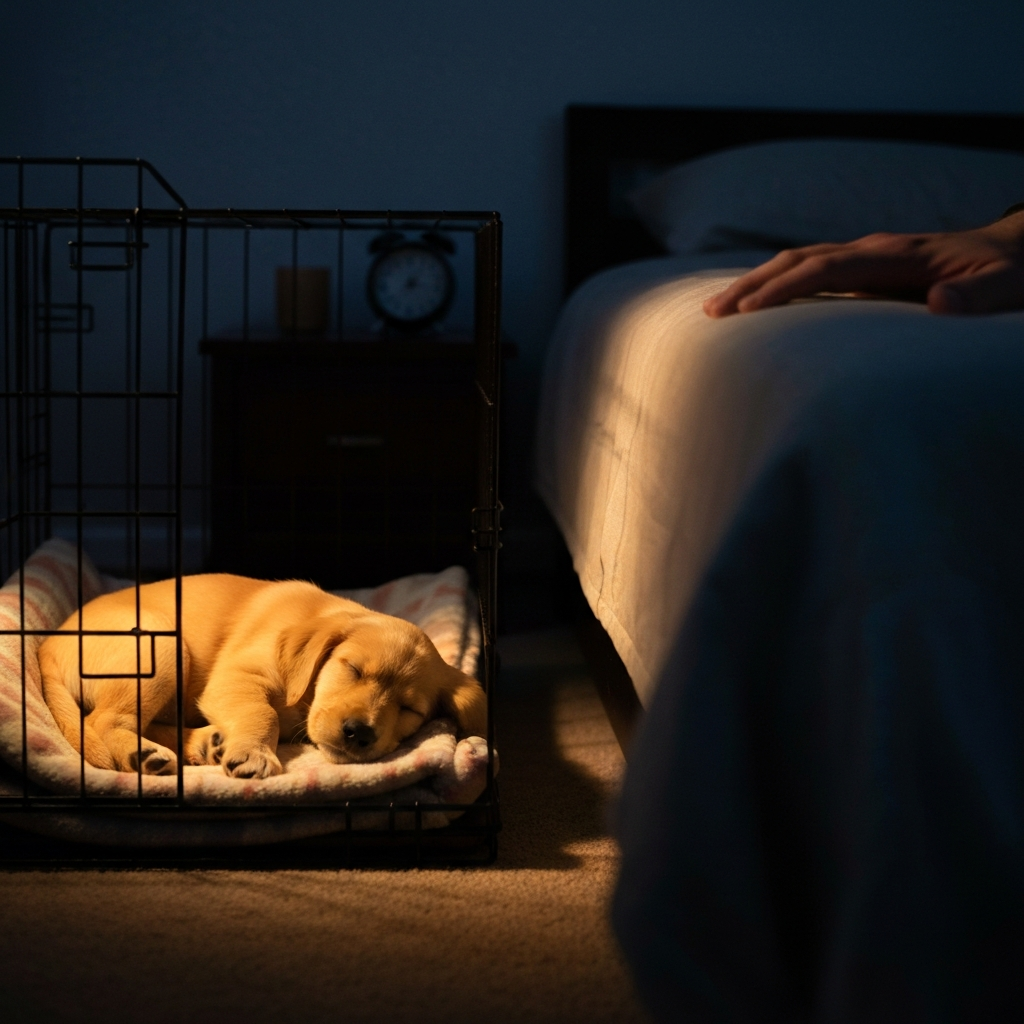

The constraint is physical before it's anything else. A puppy's bladder is genuinely tiny, and the muscles that control it haven't finished developing. At eight weeks old, most puppies simply cannot hold urine for more than two to three hours — sometimes less. Their sleep cycles are also shorter than an adult dog's, which means they naturally surface into lighter sleep more often and more easily.
This is genuinely hard, and it's also temporary. Those two things are both true, and neither one cancels the other out. You are not doing anything wrong by feeling exhausted. Broken sleep at 3 a.m., 4 a.m., and 5 a.m. wears anyone down. The fact that it's developmentally normal doesn't make your tiredness less real.
There is some variation between puppies. Smaller breeds have smaller bladders and may need more frequent nighttime trips early on. Larger breeds tend to develop a bit more bladder capacity sooner. A puppy recovering from illness or stress may take longer to settle into a predictable rhythm. But across all these differences, the underlying biology is consistent: puppy bodies are works in progress, and sleep disruption is part of that progress.
What Your Puppy's Sleep Pattern Actually Tells You
Picture a 10-week-old puppy waking every two to three hours through the night. That pattern has a straightforward explanation: a full bladder. At that age, in most cases, your puppy isn't anxious, isn't hungry, and isn't trying to manipulate you. Their body has filled up and it's asking to be emptied. The correct response is to take them outside, let them go, and put them back to bed.
Normal night waking looks like this: puppy stirs, whines or fusses, goes out, eliminates, comes back in, and settles within a few minutes. That cycle, however annoying, is healthy. What deserves more attention is when the pattern breaks from that script. A puppy that whines continuously and cannot settle even after a bathroom break, that paces or seems distressed, or that refuses to return to sleep after eliminating may be telling you something different. Persistent restlessness, especially combined with other symptoms like loose stool, excessive thirst, or lethargy, is worth a call to your vet.
A lot of owners fall into the guilt trap here. They interpret night waking as a sign that the crate is cruel, that the puppy is lonely, or that something about the setup is wrong. In most cases, that reading misses the mark. Puppies wake because their bodies need to eliminate — not because they're suffering. A crate that's appropriately sized, placed somewhere the puppy can hear household sounds, and associated with positive experiences during the day is not a source of distress. Night waking and crate aversion are different problems, and conflating them usually makes both worse.
Setting Up a Sleep Schedule That Works
Here's a realistic age-based picture of what to expect:
At 8 weeks, expect three to four night wakings. Some puppies may need more. This is the baseline, not a sign anything is off.
By 12 weeks, most puppies are down to two to three wakings, and stretches of three to four hours between trips are common.
At 16 weeks, one to two wakings is typical, and the stretches between them are getting longer.
By six months, many puppies can make it through a full night — roughly seven to eight hours — without needing to go out. Not all of them will, but physiologically, most are capable by this point.
The mechanics that support this progression matter a lot. Feed your puppy their last meal three to four hours before bedtime so their digestive system has time to do its work before you go to sleep. Pull water access about two to three hours before bed — this isn't deprivation, it's timing. Take them on a potty break right before you settle them for the night. And place the crate somewhere they feel connected to the household — a bedroom is often ideal, so they can hear you breathing without needing to wake anyone to know they're not alone.
Consistency matters more than any single tactic here. Puppies learn when the routine is predictable. They don't learn as quickly when the schedule shifts based on your evening plans or how tired you are. That's not a criticism — it's an honest acknowledgment that this part requires discipline from the human end, not just the puppy end.
Making Nighttime Wakings Boring (So They Stop Happening)
There's a principle at work in nighttime puppy care that's worth understanding clearly: every time you respond to a waking with something engaging — talking, petting, playing, turning on lights, bringing the puppy into bed — you make it more likely the puppy will wake again tomorrow night looking for the same thing. This isn't the puppy being manipulative. It's just how learning works.
Picture the scenario: puppy cries at 3 a.m., owner scoops them up with soft words, cuddles them for a bit while they wait to see if they settle, then maybe brings them to bed. The puppy may go back to sleep. But what the puppy has also learned is that 3 a.m. crying produces warmth, attention, and human contact. That's a rewarding outcome, and puppies repeat rewarding outcomes.
The correct response to a genuine night waking looks deliberately dull. Keep the lights dim. Don't talk beyond a quiet, neutral word or two. Take the puppy directly outside, wait for them to eliminate, then return them to the crate and leave. No play, no prolonged cuddles, no celebration. You want the puppy to experience nighttime as boring — a place where nothing interesting happens and the fastest route back to comfort is going back to sleep.
One common mistake worth flagging: owners who try to tire the puppy out before bed with a long play session or intense exercise. The idea makes sense on paper, but an overtired, overstimulated puppy often sleeps worse, not better. A calm, short potty walk before bed and quiet settling time in the crate beats a frantic game of tug at 9 p.m. A tired puppy and an overstimulated puppy can look similar — the difference shows up at midnight.
When to Worry: Signs Something Else Is Going On
Most puppy sleep struggles are simply puppies being puppies. But there are signs that warrant a vet visit rather than more patience.
Excessive thirst or dramatically increased urination during the day can point to underlying health issues that need evaluation.
Frequent daytime accidents in a puppy who was previously doing better may signal a urinary tract infection — common in young dogs and easily treated once diagnosed.
Lethargy, fever, changes in appetite, or loose stool alongside sleep disruption are reasons to call your vet rather than wait it out.
A sudden regression — a puppy who was sleeping in four-hour stretches and now wakes every hour — especially after a period of improvement, is worth getting checked out.
It also helps to distinguish between normal puppy sleep struggles and something behavioral developing. A puppy that wakes, goes outside, pees, and settles back down is on track, even if the frequency is frustrating. A puppy that wakes, goes outside, pees, and then cannot settle — or that escalates into prolonged distressed whining regardless of bathroom breaks — may be developing anxiety or a learned habit of expecting extended attention at night. These are different problems with different solutions.
If you want a simple way to assess where you stand: Is your puppy healthy, with no signs of illness? Is the schedule genuinely consistent, including the last meal and water times? Is your response to night waking kept boring and brief? If you can honestly say yes to all three and your puppy is under four months old, the most useful thing you can do is wait. Development is doing its job. If your puppy is past four months and still waking multiple times nightly despite a solid routine, that's a reasonable time to loop in your vet or a qualified trainer to rule out other factors.
Getting through the newborn puppy phase on broken sleep is a genuine feat. Give yourself credit for showing up at 3 a.m., night after night, for a creature who will one day sleep soundly through until morning and have no memory of any of it.
Frequently Asked Questions
At what age do puppies typically sleep through the night?
Most puppies can sleep through the night — roughly seven to eight hours without needing a bathroom break — by around six months of age. Before that, expect one to two wakings at four months, two to three at twelve weeks, and three or more at eight weeks. These are averages; some puppies settle earlier, some a little later.
Is it normal for a 10-week-old puppy to wake up every 2 hours at night?
Yes, completely normal. At ten weeks, a puppy's bladder is small and can't hold urine for long. Waking every two to three hours to eliminate is expected at that age. As long as the puppy goes out, pees, and settles back down, the pattern is healthy — just exhausting.
Should I ignore my puppy crying at night, or always respond?
If your puppy is under four to five months old, most night crying is a genuine need to go to the bathroom — ignoring it will usually result in an accident in the crate. Respond, but keep it boring: dim lights, minimal talking, straight outside, back to bed. What you want to avoid is turning night wakings into social events, which teaches the puppy that crying at 3 a.m. produces fun things.
How do I know if my puppy's nighttime restlessness is a health problem?
Normal night waking follows a pattern: the puppy stirs, goes outside, eliminates, and settles. Signs that warrant a vet call include continuous whining that doesn't resolve after a bathroom trip, a sudden change in sleep pattern after things were improving, excessive daytime thirst, frequent accidents, or any combination of restlessness with lethargy, fever, or digestive changes.
Does crate training help puppies sleep through the night faster?
A properly introduced crate can support better sleep by giving the puppy a defined, calm space and helping you manage the nighttime routine. It doesn't speed up biological development — a puppy's bladder matures on its own timeline — but consistent crate use paired with a predictable schedule tends to reduce the length of the difficult phase compared to less structured approaches.