How to Watch the World Cup With Your Dog (Without Losing Your Mind)
By Team · July 20, 2026
Category: exercise-enrichment
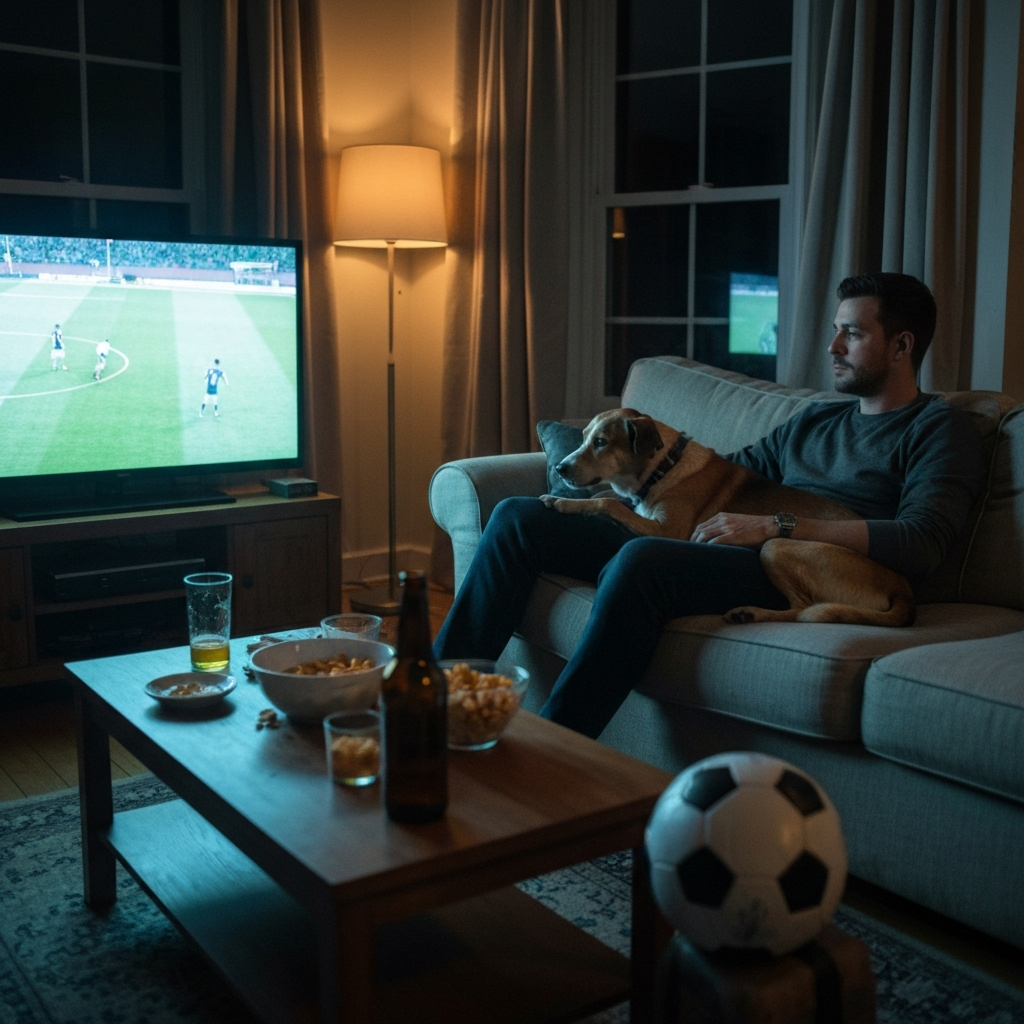
Planning a World Cup watch party with your dog doesn't have to be a battle — here's how to manage their energy, set up the environment, and actually enjoy the match.
Key takeaways
The problem Dogs are built for movement and engagement, which puts them at odds with the long, stationary nature of a watch party, and owners end up managing their dog instead of enjoying the match.
Core insight Tiring your dog out before kickoff and timing enrichment to start the moment you sit down turns the match into a calm, rewarding experience for both of you rather than a battle for attention.
Practical outcome You can plan a pre-match exercise session, prepare enrichment items to introduce at kickoff, and set up a quiet zone so you have a clear, practical routine ready before the next match.
The World Cup comes around every four years, and when it does, you want to actually watch it — not spend ninety minutes negotiating with a dog who has decided your lap is the only acceptable viewing position. Hosting a watch party with your dog in the house is completely doable, but it takes a little planning. Not because dogs are difficult, but because a dog's needs and a stationary two-hour event are a natural mismatch.
Here's how to set both of you up so the match is something you can actually enjoy.
Why Your Dog Gets Restless During Long Events
Picture this: it's fifteen minutes into the second half, you're locked in, and your dog has nudged your arm for the fifth time in ten minutes. You're not imagining it getting worse as the match goes on. Dogs are built for movement and intermittent mental engagement. A quiet room with humans staring at a screen for ninety minutes gives them almost nothing to do — and a dog with unmet physical and mental needs will fill that gap however they can.
This isn't a behavioral flaw. It's a dog doing exactly what dogs do when their needs aren't being met. Under-exercised dogs have literal excess energy with nowhere to go. Dogs who haven't had mental stimulation that day are looking for any kind of engagement — and your arm is right there. Dogs who are sensitive to noise may be responding to the crowd roar from the TV, the sudden burst of commentary after a goal, or the volume spike when your friends start shouting. Any of those can flip a dog from settled to alert without warning.
Knowing which of these is driving the restlessness tells you which lever to pull. A dog who's been on the couch all day needs physical output before the match. A dog who startles at crowd noise needs environmental management. A dog who goes for your lap the moment you sit still needs something else to do with their brain.
Pre-Game Prep: Tire Your Dog Out Before the Whistle Blows

The single most effective thing you can do to have a calm dog during a watch party happens before the match starts. A dog who gets a solid run or play session in the hour before kickoff is a fundamentally different animal than a dog who hasn't been out since the morning walk.
A 45-minute walk or fetch session doesn't just empty the tank physically — it also engages the brain. Sniffing, navigating terrain, tracking a ball: all of it adds up to a dog whose nervous system is satisfied rather than searching for input. That dog will settle on a mat or in their bed and stay there. The dog who hasn't had that release will find ways to demand your attention from the first whistle.
Match the exercise to the dog. High-drive breeds — border collies, vizslas, working-line retrievers, shepherds — need something more than a slow walk. Fetch in the garden, a run, or a vigorous play session with another dog will get them where they need to be. Bulldogs, basset hounds, older dogs, and lower-energy breeds can often settle after a good 30 to 40-minute walk with plenty of sniffing time. Sniffing is mentally exhausting in the best possible way — let them take their time at every lamppost if that's what they want.
Timing matters. Aim to finish exercise around 30 to 45 minutes before kickoff. That gives the dog time to wind down, have water, and settle before the match starts. If you exercise them right up to the opening whistle and then immediately sit down, they may still be in an activated state. Build in that buffer.
Mental Enrichment During the Match: Keeping Them Occupied Without Your Attention
Exercise gets you through the first half. Enrichment gets you through the second.
The goal is to give your dog something genuinely engaging to do at the same moment you sit down — so the trigger of you going stationary becomes associated with them getting something good, rather than being a signal to start demanding attention.
A few options that actually work for sustained engagement:
A frozen Kong stuffed with something your dog finds compelling — peanut butter, wet food, banana. Freeze it the night before. A frozen Kong takes significantly longer to work through than a room-temperature one, which is exactly what you want during a 45-minute half.
Long-lasting chews like bully sticks or yak chews give dogs something to do with their jaw and keep them anchored to one spot. These work best for dogs who are settled enough to stay on a mat — if your dog tends to wander, pair the chew with a sniff mat or a spot they're trained to go to.
Puzzle feeders and sniff mats work by making the dog use their nose or their problem-solving to access food. Both are genuinely tiring in a way that a plain chew isn't. A sniff mat scattered with small kibble or treats will occupy most dogs for 10 to 20 minutes and leave them noticeably calmer afterward.
The timing here is specific: introduce the enrichment as the match starts, not before. If you give your dog their frozen Kong twenty minutes before kickoff, they'll have finished it by the time you sit down and will still be looking for something to do. Reserve it for the moment you need it.
Novelty also matters more than you'd expect. A toy your dog has had all week is not as engaging as one they haven't seen in a few days. Rotate your enrichment options. If you have a puzzle feeder, a sniff mat, and a frozen Kong, spread them across the match rather than offering all three at once. Save the highest-value item — whatever your dog finds most compelling — for the point in the match when you most need them settled.
Managing the Environment: Sound, Space, and Boundaries
Watch parties are loud. Even if it's just you and a few friends, the TV volume during a match is higher than usual, goals and near-misses produce sudden bursts of noise from both the screen and the room, and that unpredictability is genuinely alerting for a lot of dogs.
A dog who hears a roar from fifty thousand people at 70 decibels through a television speaker, followed by three humans jumping up and shouting, is going to respond to that. For most dogs it's a moment of alert and then settling back down. For noise-sensitive or anxious dogs, each of those spikes is a stressor, and after enough of them across ninety minutes, the dog's baseline arousal level has crept up without either of you quite noticing why they're now pacing.
A few practical adjustments:
If your dog is noise-sensitive, set up a quiet zone in a different room — a bedroom with the door slightly open, or their crate in a space where the TV isn't directly audible. White noise from a fan or a calming music app can help mask the sudden peaks without completely removing ambient sound.
Keep guests aware of how the dog tends to respond. A roomful of people who know not to loudly approach or excite the dog between goals will make a difference. Dogs who are used to being greeted by strangers will often escalate their own behavior in response to each new arrival if the introductions happen repeatedly throughout the evening.
A designated mat or bed positioned away from the main seating area gives the dog a clear place to be. This works better if the dog already has some foundation with mat training — if they know that going to their mat means a reward, you can send them there as the match starts and reinforce them for staying. Even without formal training, a familiar bed with a high-value chew on it will anchor most dogs more effectively than letting them choose their own spot, which is usually your feet.
The mat placement matters. Too close to the action and the dog stays involved in everything happening on screen. Far enough away that the TV isn't immediately in their sightline, but not so isolated that they feel cut off from you — most dogs settle better when they can see their owner, even from a distance.
Halftime and Beyond: Resetting When Energy Dips
The honest reality is that most dogs' enrichment attention spans don't cover a full ninety-minute match. A frozen Kong is gone in twenty minutes. A bully stick loses its appeal once the novelty fades. Around halftime, you'll often see a dog who was settled start to shift — getting up, checking in with you, looking for something to do.
Halftime is not an interruption. It's a built-in reset, and using it deliberately makes the second half easier.
A 10-minute walk outside does more for the second half than any enrichment toy. It gives the dog a bathroom break, resets their arousal level, and gives you a moment away from the screen — which most dogs find reassuring. If a walk isn't possible, a quick play session in the garden or five minutes of training (sit, stay, a few tricks, anything that asks the dog to think) will do the same job. Training is mentally tiring, and five minutes of focused work often buys you another thirty minutes of calm.
When you come back in, bring a fresh enrichment option — whatever you held back from the first half. That novelty matters again here. A sniff mat that's been sitting on the floor since kickoff is less interesting than one that reappears at halftime.
Some dogs settle better after a break. Others struggle more in the second half regardless of what you do. If you have a dog who typically hits a wall around the 60-minute mark, plan for that. A second walk, a crate break with a chew, or moving them to the quiet room for the final thirty minutes is not a failure — it's reading your dog accurately.
When Your Dog Needs to Sit This One Out
Not every dog can handle a full watch party, and it's worth saying that directly. Some dogs are genuinely anxious in the presence of crowd noise, the energy of multiple excited people, or the sustained unpredictability of a long event. Recognizing when your dog is struggling — rather than just pushing through — is part of owning a dog well.
Signs that a dog is struggling rather than just bored: persistent panting when the room isn't warm, low-level whining that doesn't stop, pacing that doesn't resolve when you redirect them, destructive behavior, or visible signs of stress like yawning repeatedly, lip-licking, or tucked body posture. A bored dog is usually looking for engagement. An anxious dog is trying to cope with something they can't escape.
If that's your dog, the kindest thing isn't to try harder with enrichment. It's to remove the source of stress.
Practical options: hire a dog walker to take them out for the duration of the match. Set up a friend's home as a temporary playdate location — another dog's company in a quiet house often works better than a solo crate. Or simply set your dog up in a separate room with their bed, a chew, and white noise on before the match starts, and check in at halftime.
If the anxiety pattern shows up consistently — not just at watch parties but during thunderstorms, fireworks, or any sustained loud event — that's worth a conversation with your vet. A certified applied animal behaviorist or a veterinary behaviorist can assess what's driving it and whether behavioral support or medication is appropriate. Managing it with enrichment and environment helps, but it doesn't address the underlying anxiety response.
A dog who sits out the match in a calm room is having a better evening than a dog who spends ninety minutes in a state of stress. Plan accordingly, enjoy the football, and check on them at halftime.
Frequently Asked Questions
How do I stop my dog from bothering me during a long football match?
The most effective approach starts before the match. A solid 45-minute walk or play session in the hour before kickoff takes the edge off physical restlessness. During the match, give your dog something genuinely engaging to do — a frozen Kong, a sniff mat, or a long-lasting chew introduced right as you sit down. If your dog still pesters you, they likely need more pre-match exercise or a higher-value enrichment option.
Can dogs get anxious from TV noise during a watch party?
Yes. Sudden loud sounds from a television — crowd roars, commentary spikes, your friends cheering — can trigger alertness or low-level stress in noise-sensitive dogs. Signs include panting when the room isn't warm, pacing, or repeated startling. If your dog struggles with TV noise, set up a quiet zone in another room with white noise or calming music running, and let them spend the match there rather than in the thick of it.
What enrichment toys work best to keep a dog calm during a long event?
Frozen Kongs, sniff mats, puzzle feeders, and long-lasting chews like bully sticks or yak chews all work well. Freeze the Kong the night before for maximum duration. Introduce the enrichment exactly when the match starts — not before — so the novelty is fresh when you need it. Rotate options between halves rather than offering everything at once, and save the highest-value item for the point in the match when your dog tends to peak in restlessness.
What should I do at halftime to help my dog get through the second half?
Use halftime as a reset. A 10-minute walk outside is the most effective option — it gives your dog a bathroom break and drops their arousal level. If that's not possible, five minutes of training (