How to Read a Pet Food Label Without Getting Confused
By Simone Varga · May 6, 2026
Category: nutrition-diet
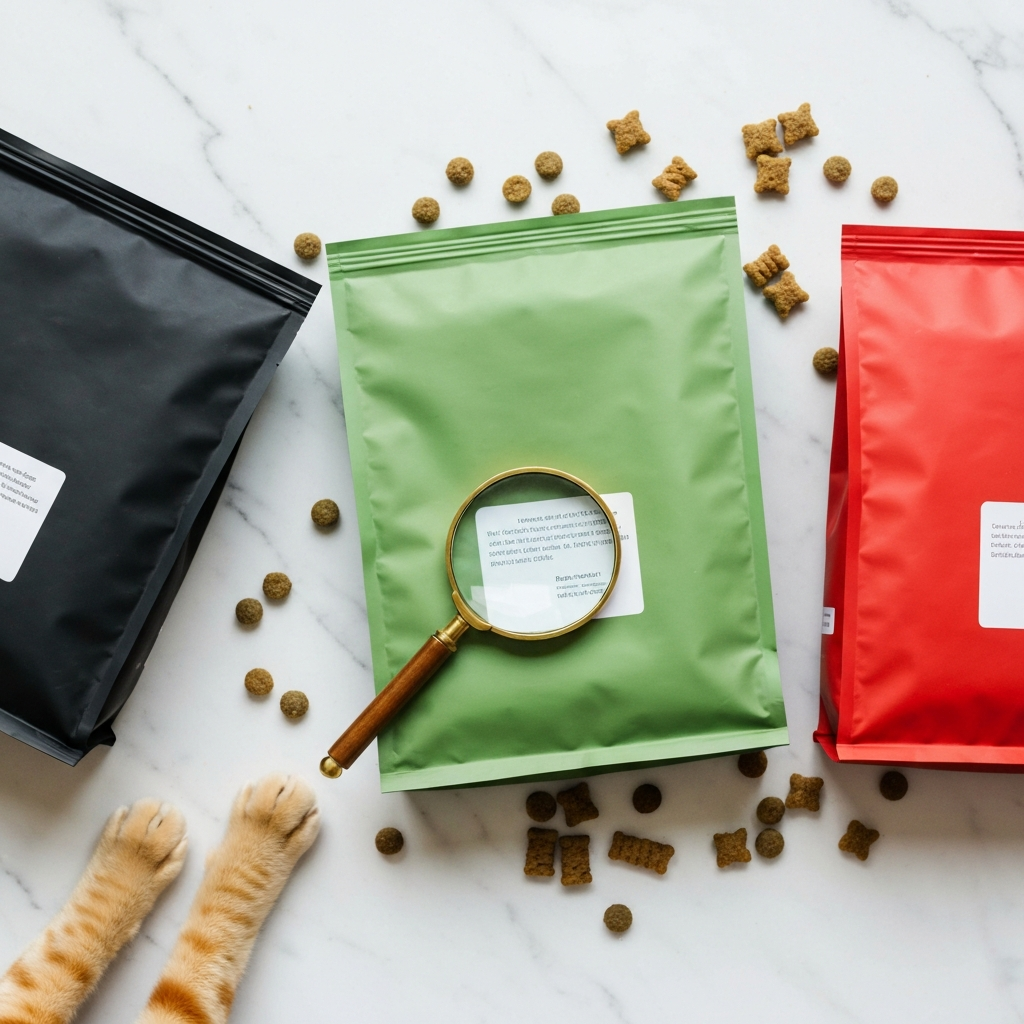
Pet food labels are packed with confusing claims and fine print - here's how to read them without getting lost in the marketing.
Key takeaways
The problem Pet food packaging mixes regulated nutrition information with marketing, making both hard to tell apart.
Core insight The nutritional adequacy statement tells you more about a food's quality than any front-of-bag claim.
Practical outcome You can filter pet foods faster by checking the adequacy statement, ingredient specificity, and life stage match.
The bag has a golden retriever on it, mid-leap, tail blurred with joy. The name is something like Prairie Harvest Meadow Blend with Ancient Grains and Real Chicken. It costs more than your last grocery run. And somewhere on the back, in a font apparently designed for people with better eyes than yours, is a nutrition label that reads like a chemistry exam you didn't study for. If you've ever stood in a pet food aisle for fifteen minutes and walked out less confident than when you walked in, you're not doing it wrong. The labels are genuinely confusing.
Reading a pet food label is one of those skills nobody teaches you but everyone assumes you have. This guide walks through the main sections of a standard pet food label - what they mean, what to actually look for, and which claims you can safely ignore without losing sleep over it.
Understanding What a Pet Food Label Is Actually Telling You
A pet food label in the US is regulated by two bodies: the Association of American Feed Control Officials (AAFCO) and, to a lesser degree, the FDA. AAFCO sets the nutritional standards; manufacturers are required to follow specific rules about what goes on the label and how it's worded. This matters because those rules are doing a lot of quiet work in the background - and once you know a few of them, the label starts making a lot more sense.
The main sections you'll encounter are the product name, the ingredient list, the guaranteed analysis, the nutritional adequacy statement, and feeding guidelines. Each one tells you something different. They don't all carry equal weight, and they don't all mean what they sound like they mean.
Why Pet Food Labels Feel So Hard to Decode
Part of the problem is that pet food marketing and pet food nutrition are sharing the same real estate on the bag. The front of the package is pure marketing. The back is regulated information. But they're designed to feel like one coherent story, and that's where the confusion sets in.
When a bag says with Real Salmon, that phrasing - "with" - actually has a specific legal meaning under AAFCO rules. It means the product only needs to contain 3% of that ingredient. "Salmon Recipe" or "Salmon Dinner" requires 25%. A product simply called "Salmon" must be at least 95% salmon (excluding water). That's a massive range, and the packaging is under no obligation to make it obvious which category you're looking at.
Add to that the fact that ingredient lists are ordered by pre-cooking weight, which means a whole chicken listed first can shrink significantly once moisture is removed - and suddenly that "chicken as the first ingredient" claim looks a bit more complicated. None of this is illegal. It's just not designed to make your life easy.
Start With the Nutritional Adequacy Statement
Skip the front of the bag entirely and go straight to the nutritional adequacy statement. It's usually a small block of text somewhere on the side or back, and it's the single most useful sentence on the whole package.
You're looking for language like: "[Product name] is formulated to meet the nutritional levels established by the AAFCO [Dog/Cat] Food Nutrient Profiles for [life stage]." That tells you the food has been formulated to meet a recognized standard for a specific stage of life - puppy, adult, senior, all life stages, and so on.
Some labels say "for all life stages" which sounds reassuring but actually means the food meets puppy or kitten nutritional requirements, which are higher. For an adult or senior animal, that may mean more of certain nutrients than they need. It's not dangerous, but it's worth knowing. If your pet has specific health considerations, checking that the life stage matches is a quick filter that costs you about four seconds.
Read the Ingredient List Without Spiraling
The ingredient list runs from most to least by pre-cooking weight. The first five or six ingredients are doing the most work, nutritionally speaking, so that's where to focus your attention.
Named protein sources - chicken, beef, salmon, lamb - are more specific than vague terms like "poultry" or "meat," which can mean a wider range of things. "Chicken meal" sounds worse than "chicken" but is actually a concentrated protein source with moisture already removed, so it may contribute more protein by weight in the finished product than fresh chicken listed first.
Ingredients like "chicken by-products" often get a bad reputation, but by-products in pet food include organ meats - liver, kidney, heart - which are genuinely nutritious. The concern is more about consistency and quality control than inherent danger. By-product meal, especially unspecified ("poultry by-product meal" rather than "chicken by-product meal"), is where things get murkier.
Preservatives, colorings, and additives are worth a scan. Synthetic preservatives like BHA, BHT, and ethoxyquin have been subjects of ongoing concern in the pet nutrition community, though research is not conclusive. Natural preservatives like mixed tocopherols (a form of vitamin E) or rosemary extract are more commonly seen in premium foods. If a long list of artificial colorings appears, ask yourself why kibble for a dog - an animal with limited color vision - needs to be visually appealing. The answer is: it doesn't. That's for you.
Use the Guaranteed Analysis as a Starting Point, Not a Final Answer
The guaranteed analysis lists minimum percentages of crude protein and crude fat, and maximum percentages of crude fiber and moisture. The word "crude" here refers to the method of measurement, not the quality of the ingredient - so crude protein tells you how much protein is present but not whether it's coming from chicken breast or feathers (yes, feathers are technically protein by this measure, which is a thing that should probably be illegal to know).
These numbers are useful for comparison between similar food types - dry to dry, wet to wet - but comparing dry food to wet food directly doesn't work because of the moisture difference. Wet food might show 10% protein on the label, but once you account for the 75-80% moisture content, the dry matter protein percentage is considerably higher. There are dry matter calculators available online if you want to do an apples-to-apples comparison, and they're genuinely not that complicated once you've done it once.
For most healthy adult pets on a commercial diet, the guaranteed analysis is less important than the adequacy statement. But if your pet has a specific health condition - kidney disease, obesity, food sensitivities - the numbers become more relevant, and that's a conversation worth having with your vet rather than trying to solve off a bag.
Understand Which Label Claims Mean Something and Which Don't
"Natural" has a loose regulatory definition in pet food - it generally means no synthetic ingredients, but the term is used broadly and inconsistently. "Organic" has stricter USDA certification requirements and means more in practice.
"Grain-free" became enormously popular for a period, partly driven by the assumption that grains are fillers or that dogs are better suited to grain-free diets. The FDA began investigating a potential link between grain-free diets and a form of heart disease (dilated cardiomyopathy) in dogs around 2018, and while the research is still ongoing and no definitive causal link has been established, the initial enthusiasm for grain-free has quieted somewhat. If your dog is doing well on a grain-free food and your vet isn't concerned, that's context that matters. If you're choosing grain-free because the bag looks more premium, it may be worth reconsidering.
"Human-grade" is another one that sounds like it means something but has limited regulatory standing in pet food labeling. It can be a signal of quality manufacturing practices, but it's not a guarantee.
Claims like "supports healthy skin and coat" or "promotes digestive health" are permitted without the same evidentiary bar that a drug claim would require. They're not lies exactly - they're just not promises.
Pay Attention to Feeding Guidelines Without Following Them Blindly

Feeding guidelines on pet food bags are starting points, not prescriptions. They're based on average activity levels and average metabolic rates, which is to say they're not based on your specific animal. A ten-year-old cat who moved from a house to an apartment and now considers walking to the food bowl a form of cardio needs fewer calories than the bag suggests for her weight category. A working dog covering eight miles a day needs more.
Body condition score - a system vets use to assess whether an animal is underweight, at a healthy weight, or overweight - is more useful than any number on a bag. Most veterinary clinics can show you how to assess this at home. It involves feeling for ribs and observing waist definition, and once you know what you're feeling for, it takes about thirty seconds.
When to Bring Your Vet Into the Conversation
For a healthy pet on a commercially prepared diet, you probably don't need professional guidance every time you switch foods. But there are situations where a vet or a veterinary nutritionist is genuinely the right next step - not just a fallback.
If your pet has a diagnosed health condition, is on medication that might interact with certain nutrients, is a young puppy or kitten with rapidly changing needs, or if you're considering a home-cooked or raw diet, the label is only one piece of a bigger picture. Veterinary nutritionists specifically (board-certified, with credentials you can verify) can help formulate diets and catch deficiencies that won't be obvious from reading ingredient lists.
It's also worth mentioning that if you're getting most of your pet food information from the brand's own website or from social media accounts that seem very invested in you being afraid of mainstream pet food, a second opinion from someone with no financial stake in your choices is a reasonable thing to seek.
Pet food labels are not impossible to read - they're just written in a language that takes a few minutes to learn. Once you know that the adequacy statement matters more than the front of the bag, that ingredient order reflects pre-cooking weight, and that most front-of-bag claims are marketing rather than nutrition, you have enough to make a reasonably informed choice. You won't have all the answers. Nobody does. But you'll stop standing in the aisle for fifteen minutes, and that's worth something.
Frequently Asked Questions
What is the most important thing to look for on a pet food label?
The nutritional adequacy statement is the single most informative part of a pet food label. It tells you whether the food meets established nutritional standards for your pet's life stage, and it's regulated - unlike most of the claims on the front of the bag. Look for language referencing AAFCO nutrient profiles and a specific life stage (puppy, adult, all life stages, etc.).
Does 'chicken as the first ingredient' mean the food is high in protein?
Not necessarily. Ingredients are listed by pre-cooking weight, so a whole chicken listed first contains a lot of moisture. Once cooked, it shrinks considerably. 'Chicken meal,' which sounds less appealing, is actually a concentrated protein source with moisture already removed - it may contribute more protein to the finished product than fresh chicken listed ahead of it.
Is grain-free pet food better for dogs?
There's no strong evidence that grain-free diets are inherently healthier for most dogs. The FDA investigated a potential link between grain-free diets and dilated cardiomyopathy (a type of heart disease) in dogs, and while no definitive causal link has been established, the research is ongoing. Unless your dog has a diagnosed grain sensitivity or your vet has recommended grain-free, it's not a necessary choice.
How do I compare the protein content of wet food versus dry food?
You can't compare them directly from the guaranteed analysis because wet food contains far more moisture - typically 75-80% - which dilutes the percentages. To compare them accurately, you need to calculate dry matter percentages. Subtract the moisture percentage from 100 to get the dry matter percentage, then divide the nutrient percentage by that number. Dry matter calculators are available online and make this much easier to do in practice.
When should I consult a vet about my pet's diet instead of just reading the label?
If your pet has a health condition like kidney disease, diabetes, or food allergies, or if you're considering a home-cooked or raw diet, a label alone won't give you what you need. A veterinary nutritionist - a board-certified specialist, not just a general vet - can help design a diet that meets your pet's specific requirements. For healthy pets on commercial food, an annual check-in with your regular vet about weight and body condition is usually enough.