Common Dog Behavior Issues & Practical Fixes
By Team · July 1, 2026
Category: training-behavior

Understanding the root causes behind common dog behavior issues - and applying a few practical, consistent strategies - can make real progress possible for both of you.
Key takeaways
The problem Common dog behavior issues like jumping, barking, and chewing frustrate owners, but these behaviors are communication attempts rather than character flaws that need to be understood and addressed.
Core insight Most behavior problems stem from unmet needs like exercise, mental stimulation, or unclear boundaries, and respond better to consistent positive reinforcement than to punishment or correction.
Practical outcome You can make real progress by redirecting unwanted behaviors to desired ones, managing your dog's environment to prevent problems, meeting exercise and mental stimulation needs, maintaining consistent household rules, and seeking professional help when behaviors involve aggression or severe anxiety.
Most dog owners hit a wall at some point. The jumping that seemed cute in a puppy is now knocking over your grandmother. The barking that started occasionally is now happening every time a leaf blows past the window. If you are dealing with common dog behavior issues, you are not alone - and your dog is not broken.
These problems are some of the most searched and most frustrating parts of dog ownership. The good news is that most of them respond well to consistent, humane approaches that do not require professional tools or a trainer's budget. What they do require is some patience, some strategy, and an honest look at what might be driving the behavior in the first place.
Understanding Common Dog Behavior Issues
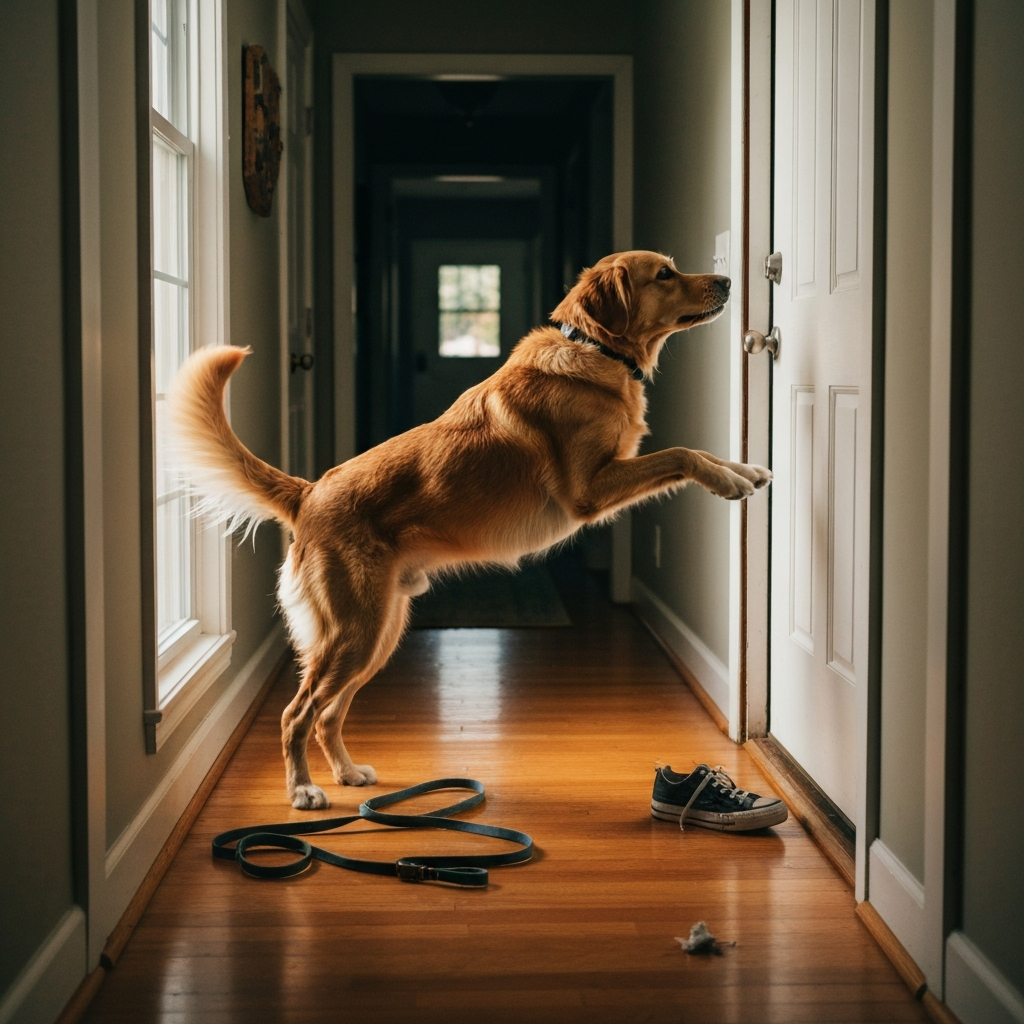 common dog behavior issues and categories." loading="lazy" />
The five behavior problems that come up most often for owners are jumping on people, excessive barking, pulling on the leash, destructive chewing, and resource guarding. Each one is frustrating in its own way, but none of them means you have a bad dog.
These behaviors almost always have a cause. A dog jumping on guests is not being disrespectful - it is trying to get close to a face, the way dogs greet each other. It is seeking attention and connection. The behavior is the dog's attempt to communicate something, not a character flaw you need to discipline out of it.
Context also matters more than people often realize. A puppy chewing everything in sight is doing something developmentally normal - its gums hurt, it is curious, it is exploring the world with its mouth. An adult dog that suddenly starts destroying furniture after years of calm behavior is telling you something has changed: its routine, its stress levels, something. Treating both situations the same way will not work. The starting point is understanding what is actually going on.
Why This Happens: The Root Causes Behind Behavior

Take excessive barking as an example of how these cycles form. A dog barks at the door. The owner yells "quiet!" The dog has no idea what "quiet" means, but it got a loud, animated response from you. From the dog's perspective, barking worked - something happened. Over time, the dog learns that barking gets a reaction, and the behavior gets stronger, not weaker.
Most behavior problems trace back to a handful of root causes. Lack of exercise is a big one: a high-energy dog left alone all day will find its own outlets, and those outlets are rarely what you would choose. Boredom runs parallel to this - a dog with nothing to do will make something to do. Anxiety is another major driver; dogs that are worried or overwhelmed often express it through behaviors that look like defiance but are actually distress. And then there is simply a lack of training - a dog that has never been taught what to do cannot be expected to do it.
Genetics play a role too, and it is worth naming that plainly. Herding breeds nip and circle. Terriers chase and dig. Retrievers carry things in their mouths. These are not problems - they are behaviors that were selectively bred over generations. Knowing your dog's breed tendencies helps you work with the dog's instincts rather than against them, which makes everything easier.
Strategy 1: Redirect and Reward the Behavior You Want
Redirection is one of the most practical tools you have. Rather than punishing a behavior you do not want, you teach and reward the behavior you do want instead. It sounds simple, and the principle is - but the execution takes real attention.
Here is how it works with jumping. A guest arrives at the door. Your dog runs over and starts jumping. Instead of pushing the dog down or saying no, you ask the dog to sit. The moment the dog sits, the guest greets it calmly and warmly. The dog gets what it wanted - attention and connection - but through a different behavior. Over time, your dog starts to understand that sitting is what makes good things happen when people arrive.
Timing is everything here. The reward - whether that is a treat, praise, or affection - needs to come within a second or two of the correct behavior. If you wait too long, the dog cannot make the connection between what it did and what it received. This is why training sessions work better than occasional corrections: the more repetitions your dog gets, the clearer the pattern becomes.
Be honest with yourself about the patience this requires. Most people improve for a few days and then revert when they are tired or distracted. That inconsistency is actually when progress is lost. You do not have to be perfect, but the more consistent you can be, the faster the behavior shifts.
Strategy 2: Manage the Environment to Prevent the Problem
Management means changing the environment so the problem behavior cannot happen, rather than waiting for the dog to make the wrong choice and then reacting. This is not a long-term fix on its own, but it is an important bridge while you work on training.
A practical example: if your dog chews furniture when left alone, do not leave your dog alone with access to the furniture. Use a crate or confine the dog to a room with chew-appropriate toys. The dog is not being punished - it is being set up in a situation where it can succeed rather than fail. That distinction matters.
Useful management tools include baby gates to limit access, crates used positively and not as punishment, puzzle toys that give a dog something appropriate to do, a good exercise session before you leave, and background noise like a radio or white noise machine for dogs that get anxious in a quiet house. None of these tools are permanent solutions. They buy you time and reduce the number of repetitions of the unwanted behavior while you work on teaching the dog what you actually want.
Management is not giving up or admitting defeat. A dog cannot learn to be calm if it is constantly put in situations where it is overwhelmed and makes the wrong choice. Reducing those failures while building new habits is just good strategy.
Strategy 3: Exercise and Mental Stimulation
A significant number of behavior problems are simply the result of a dog that has too much energy and nowhere to put it. A dog bouncing off the walls when you get home, barking at everything, or chewing through a couch cushion is often not a training problem - it is an exercise and enrichment problem.
Physical exercise and mental stimulation are both important, and they are not the same thing. A long walk burns energy through movement. A sniff-focused walk - where you let the dog stop and smell everything rather than pulling it along at your pace - engages the brain in a way that physical exercise alone does not. Mental work like training sessions, puzzle toys, or hide-and-seek games with treats often tires a dog faster than a run does, because the brain is working hard.
Rather than a vague suggestion to "exercise more," here are some realistic starting points. A 20-minute walk in the morning followed by 10 minutes of sniff exploration or a short training session gives many dogs what they need to settle. A puzzle feeder for breakfast, instead of a bowl, adds mental work with no extra time from you. If you work from home, two or three 5-minute training sessions spread through the day can make a real difference in a dog's behavior by evening. These do not have to be long or elaborate to count.
Strategy 4: Set Clear Boundaries and Consistency
Dogs do not thrive in ambiguity. When the rules change depending on the day, or on who is home, or on how tired you are, the dog is left guessing - and guessing usually means testing. A dog that is allowed on the couch sometimes and corrected for it other times does not learn to stay off the couch. It learns that the couch situation is unpredictable, and it will keep trying to figure out when the answer is yes.
The most common stumbling block here is not the dog - it is the humans. If one person in the household allows jumping as a greeting and another does not, the dog will keep jumping on everyone, because the behavior sometimes works. Consistency across all people who interact with the dog is not optional if you want the training to stick. This is worth an honest conversation with everyone in your household before you start working on a behavior.
Clear rules also reduce anxiety for your dog. Knowing what is expected - and experiencing a predictable response to its behavior - is actually calming for most dogs. This is not about being strict or harsh. It is about being legible to your dog, so it does not have to spend energy figuring out what the current rules are.
Strategy 5: Use Positive Reinforcement, Not Punishment
Punishment - yelling, physical correction, intimidation - feels like it works in the moment because the behavior often stops immediately. But what you are teaching the dog in those moments is that you are unpredictable and scary, not that a different behavior would have gotten a better result. A dog that stops barking because it is afraid of you has not learned to be calm. It has learned to shut down around you.
Positive reinforcement works differently. When your dog is lying quietly and you offer a treat and a calm "good dog," you are marking that state as something worth doing again. Over many repetitions, the dog learns that calm, quiet behavior gets good things. The behavior increases because it is worth it, not because the alternative is frightening. This is a slower process than a sharp correction, but the behavior that results from it is much more stable and much less likely to come with side effects like fear, hiding, or redirected aggression.
Frustration is real. There will be moments when you have corrected the same behavior for the hundredth time and you want to yell. That feeling does not make you a bad owner. It makes you human. The question is what works over time, not what provides relief in the moment - and the research on this is consistent: positive, reward-based training produces better and more lasting results than punishment-based approaches.
When to Seek Support
Some behaviors go beyond what patience and consistency alone can solve. If your dog is showing aggression toward people or other animals, experiencing severe anxiety that results in self-injury or complete panic when left alone, or if resource guarding is escalating to snapping or biting, those are signs to get professional help sooner rather than later. Any behavior that poses a real safety risk needs more than a how-to article.
There are two main types of professionals to consider, and they are not interchangeable. A certified trainer - especially one using positive, reward-based methods - can work with you on behavior modification for most everyday problems. A veterinary behaviorist is a veterinarian with specialized training in behavior, who can assess whether anxiety, pain, or a neurological issue is contributing to the problem and can prescribe medication when appropriate. If your dog's behavior seems driven by fear or anxiety rather than habit, a vet behaviorist may be the better first call.
Getting help early is not admitting failure. Behavior problems that have been repeated for months or years are harder to change than ones that are addressed early, when the patterns are less entrenched. The cost and time involved in working with a professional are real, but they are typically much less than the cost - in stress, in damage, in safety risk - of waiting.
Your dog is not trying to make your life difficult. Most of what looks like defiance or stubbornness is a dog doing the best it can with the information and environment it has. That is something you can actually work with.