Cat Fitness Games That Turn Playtime Into a Real Workout
By Team · July 20, 2026
Category: exercise-enrichment
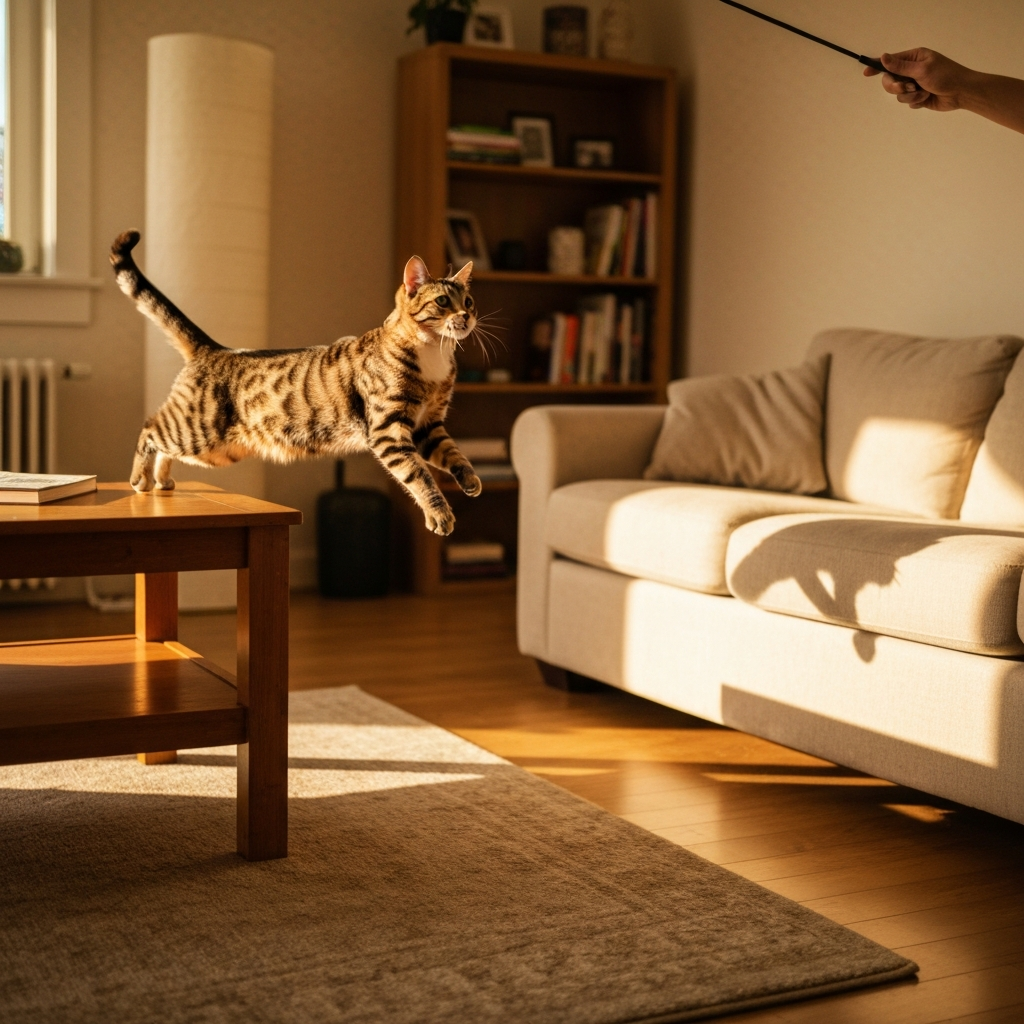
Cat fitness games can turn daily playtime into real physical and mental exercise - here's how to choose the right ones and make them actually stick.
Key takeaways
The problem Indoor cats move far less than their bodies need, leading to weight gain and behavioral problems.
Core insight Matching play to your cat's specific style - chaser or puzzle-solver - makes fitness games stick.
Practical outcome Two short daily play sessions plus simple enrichment activities will visibly improve your cat's condition within weeks.
Your indoor cat probably sleeps 16 hours a day. That part is normal. What's not normal is when the other 8 hours are mostly spent sitting by the food bowl, staring at the wall, or shredding the arm of your couch. Cat fitness games exist for a reason - and it's not just to tire your cat out before bed.
Why Cats Need Fitness Games Beyond Just Burning Energy
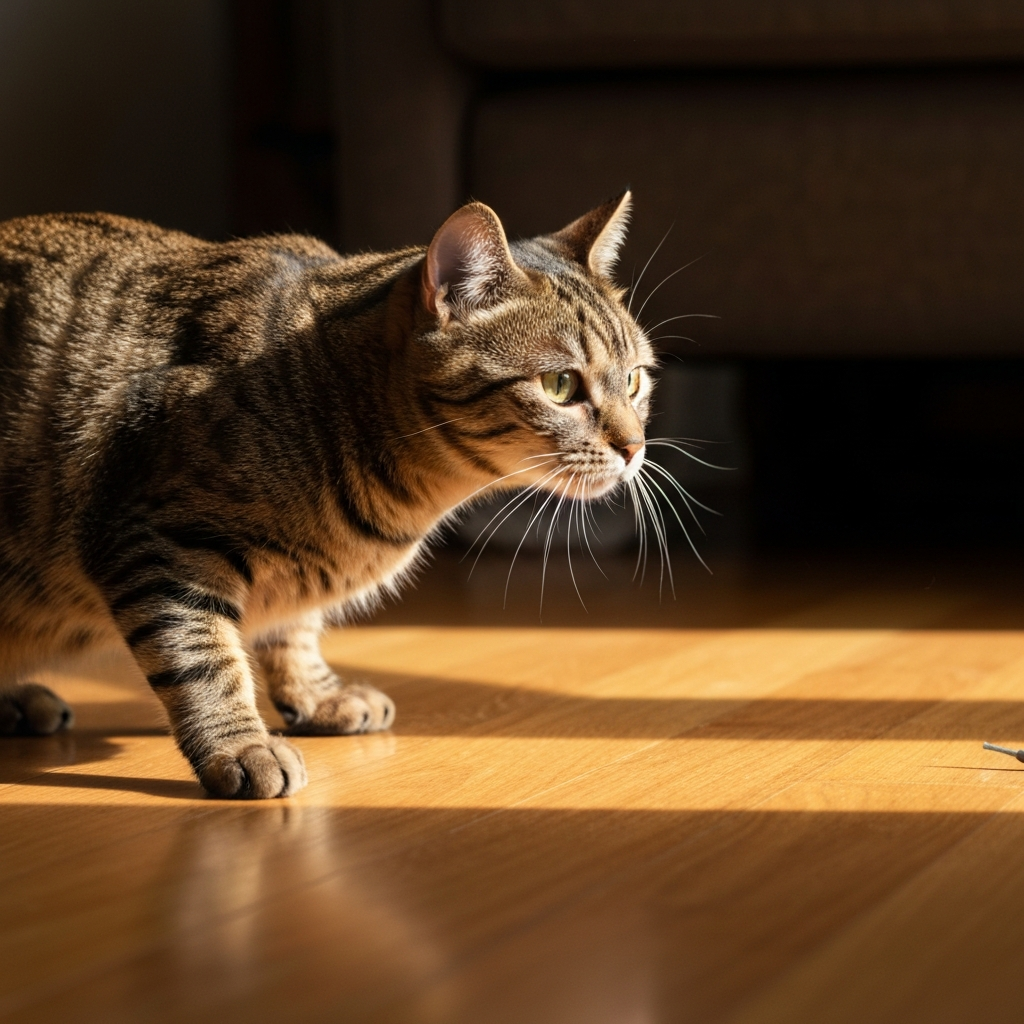

Indoor cats move a fraction of what their bodies were built to handle. A domestic cat's physical makeup hasn't changed much from its wild ancestors. It was designed to stalk, sprint, pounce, and wrestle prey multiple times a day. Instead, most indoor cats get a bowl filled twice daily and a clean litter box, and that's the extent of their physical challenge.
The consequences stack up quietly. Insufficient movement leads to boredom, and boredom in cats doesn't look like a tired dog lying on the couch. It looks like overeating, midnight zoomies that feel frantic rather than playful, scratching furniture, and sometimes refusing to use the litter box altogether. The behavior is a signal, not a personality flaw.
Picture a 3-year-old indoor tabby who's gained 2 pounds over the past year. That's roughly 15% of his body weight - equivalent to a significant jump for a person. His joints carry more load, his heart works harder at rest, and his muscle mass has quietly declined because he's not using it. He's not lazy. He's understimulated and out of condition.
Active play mimics hunting: the stalking approach, the chase, the pounce, the catch. Each phase engages different muscles and, just as importantly, gives a cat a sense of completing something. Cats who get that full sequence regularly tend to be calmer, less destructive, and better adjusted. The physical and behavioral benefits aren't separate - they run together.
Reading Your Cat's Play Style So You Pick Games They'll Actually Use
Before you buy a rotation of toys that end up ignored under the sofa, watch your cat for 3 to 5 days. Not actively - just notice. What triggers a reaction? Does she crouch and stalk the shadow from a passing car? Does she bat at dangling cords? Does she investigate every new object placed on the floor, sniffing and pawing at it methodically?
Most cats fall into one of two broad play types. Prey-drive players are chasers and pounders. They light up for fast-moving targets - a feather toy dragged across the floor, a crinkle ball skittered down the hallway. They want to pursue and catch. Puzzle-solvers are investigators. They're more interested in figuring something out than chasing it. They'll spend ten minutes pawing at a treat inside a puzzle feeder, trying different approaches. A wand toy waved quickly overhead may bore them flat. A slow-moving toy with an interesting texture will hold their attention for much longer.
Then there's the cat who just sits there and watches you wave the toy around. This isn't necessarily a low-drive cat - it's often a cat who needs a warm-up. Try starting with something low-stakes: a piece of paper on the floor, a shoelace dragged slowly past at ground level. Some cats need the stimulus to come at them rather than expecting them to go to it. If your cat eventually pounces on something after two or three minutes of apparent disinterest, that's not laziness - that's how she plays. Start slow, let her build into it.
High-Energy Games That Build Real Fitness
For actual cardiovascular work and muscle engagement, you want games that trigger the full hunting sequence: stalk, chase, pounce, catch. These are the sessions that elevate heart rate, work the rear legs and core, and give your cat something to feel genuinely accomplished about afterward.
Wand toys with feather or string attachments are the most reliable tool for this. The technique matters more than the toy itself. Drag the feather in a figure-8 pattern across the floor for about two minutes. Keep it low and unpredictable - let it disappear behind a chair leg, pause, then dart away. Your cat's heart rate climbs, her breathing deepens, and her hindquarters are doing real work with every pounce. This is not the same as dangling it overhead while she swats halfheartedly from a sitting position.
Laser pointers can work well for high-drive chasers, but they require a specific rule: never end a laser session without transitioning to a physical toy she can catch. A cat that chases a laser for five minutes and then has the light simply switched off is left with an incomplete hunting sequence. That unresolved arousal can translate to agitation, redirected aggression, or frantic pacing. Move the laser onto a toy mouse or crinkle ball at the end of the session, let her pounce on it, and the loop closes cleanly.
Tunnel chasing is underused. A fabric cat tunnel laid flat on the floor, with a toy dragged through it or tossed inside, triggers sprint-and-ambush behavior that works the full body hard in a short time. Even a short tunnel gets most cats moving faster than open-floor play.
Throw-and-retrieve with crinkle balls sounds like a dog game, but a surprising number of cats will chase and occasionally bring back small, light objects if you've caught their interest. The sprinting is the point. Even if she doesn't bring it back, the initial chase is real exercise.
The critical rule across all of these: end every session with a catch. Let her grab and hold the toy. Give her a moment to bite it, kick it with her back feet, own it. Then the session can end. Stopping abruptly while she's still aroused leaves her frustrated, and that frustration has to go somewhere.
Low-Effort Games That Keep Her Moving Throughout the Day
Not every owner can run two structured 15-minute play sessions every day. Life gets in the way. The good news is that consistent low-level movement throughout the day adds up, and several types of enrichment deliver that without requiring you to be present or actively involved.
A realistic picture of this in practice: your cat gets a puzzle feeder at breakfast instead of a bowl. It takes her 5 minutes to work the kibble out - she's using her paws, adjusting her approach, staying mentally engaged. Mid-morning, she's on the window perch watching the birds, which counts for something: the visual tracking, the chittering, the crouched readiness all activate muscles and sustain alertness. You toss a treat ball under the couch before you leave for work. She fishes it out, bats it around the kitchen, and eventually gets the treats. In the evening, you do a 10-minute wand session. That's a day with meaningful movement built in without heroic effort.
Be honest about what actually works for your specific cat. A puzzle feeder is excellent for food-motivated cats - it may completely bore a cat who isn't treat-driven. Motion-activated battery toys work well for prey-drive players who self-entertain, but a shy or anxious cat may startle and avoid them entirely. Rotating toys every few days maintains novelty, which matters more than having a large collection.
Building a Fitness Routine Without Turning It Into a Chore
The framework that actually works over time is simple: two short active play sessions per day - 5 to 10 minutes each - plus two or three passive enrichment activities spread through the day. That's it. Consistency matters far more than intensity. A cat who plays for 7 minutes every evening will be in better condition in two months than one who gets an enthusiastic 30-minute session twice a week.
The most common failure point isn't disinterest - it's the owner stopping because life got busy and the cat seemed fine without it. Cats often show a warm-up period at the start of a new routine. A cat who sits and watches the wand toy for the first three sessions isn't rejecting play - she's assessing it. Give it a week of consistent attempts before concluding it isn't working.
After 2 to 3 weeks of consistent play, you should start to see tangible signs that the routine is doing something. More spontaneous activity between sessions - a cat who starts carrying toys to you, or who greets you at the door with more energy than before. Fewer stress behaviors like over-grooming or box avoidance. If your cat was slightly overweight, you won't see dramatic changes yet, but you may notice she's more willing to jump to surfaces she'd been avoiding. These are real indicators, not wishful thinking.
When Your Cat Isn't Interested and What to Try Instead
Some cats genuinely play less. This isn't a failure, and it doesn't mean your cat is unhappy. Older cats often have joint pain that makes the pounce-and-land movement uncomfortable - they're not being stubborn, they're protecting themselves. If you have a cat over 8 years old who has become notably less active, a vet visit to rule out arthritis is worthwhile before you assume she's just gotten lazy.
Work through the diagnostic chain before giving up. Is she uninterested in all games, or only certain types? A cat who ignores wand toys but obsessively investigates a new cardboard box may be a puzzle-solver who needs different stimulation. Does she play at specific times? Many cats are most active in the early morning and early evening, aligning with natural crepuscular patterns - trying to play her during midday may simply be poor timing. Is she overweight? Excess weight makes movement genuinely harder and reduces the motivation to start.
For genuinely low-play cats, shift the focus to environmental enrichment rather than forcing interactive sessions. Vertical space - cat trees, shelves, a cleared windowsill - encourages climbing and jumping on the cat's own terms. Window access with a bird feeder placed outside provides passive but real mental engagement. Scattered feeding, where you place small amounts of food around the room instead of in a bowl, encourages sniffing and searching. These strategies won't replace active play, but they keep a low-drive cat moving more than a static bowl and an empty room will.
If your cat's disinterest in play is new and accompanied by other changes - sleeping more, eating less, hiding, or moving stiffly - don't try to troubleshoot with more games. That's a vet conversation, not a toy problem.
Frequently Asked Questions
How long should cat fitness play sessions actually be?
Two sessions of 5 to 10 minutes each per day is a realistic and effective target for most adult cats. Shorter sessions done consistently will do more for your cat's fitness and mental health than occasional long ones. The quality of engagement matters more than the clock - a focused 7-minute wand session where your cat is actively stalking and pouncing is more valuable than 20 minutes of half-hearted swatting.
Why does my cat lose interest in toys so quickly?
Cats habituate fast to objects that stop moving or stop being novel. A toy left on the floor becomes part of the furniture within a day or two. Rotating your cat's toys every 2 to 3 days - putting some away and reintroducing them later - restores novelty. For interactive play, movement pattern matters: slow, unpredictable movements that mimic prey behavior hold attention far better than fast, repetitive ones.
Are laser pointers bad for cats?
Laser pointers are not inherently bad, but they need to end correctly. The problem is that a laser can never be caught, which leaves the hunting sequence incomplete. Always transition at the end of a laser session to a physical toy your cat can grab and hold - a small mouse, a crinkle ball, anything she can bite and kick. That closes the loop and prevents the frustration and agitation that can follow an abruptly ended session.
My cat seems lazy and uninterested in play. Is something wrong?
Not necessarily, but it's worth investigating. First check timing - cats are most active at dawn and dusk, and trying to play mid-afternoon often fails. Try starting with very low-stakes movement like a slowly dragged string on the floor rather than an energetic wand session. If the disinterest is new rather than longstanding, or if it comes with other changes like reduced appetite, increased hiding, or stiff movement, have your vet check for pain or underlying illness before attributing it to personality.
How do I know if cat fitness games are actually making a difference?
After 2 to 3 weeks of consistent daily play, look for these signs: your cat initiates play more, shows more energy between sessions, or carries toys to you. You may also notice fewer stress behaviors like over-grooming or box avoidance, and a slightly more willing approach to jumping onto surfaces she'd been avoiding. These changes are subtle but real. For weight-related goals, give it at least 6 to 8 weeks before expecting visible changes, and combine play with appropriate feeding.